
How to Maximise Your Home Energy Savings: A Step-by-Step Guide for NSW Homeowners
Most NSW homeowners know that energy upgrades can save money. What fewer people realise is that there are multiple government programs available right now — and when you stack them in the right order, the combined saving can be extraordinary.
Here's the step-by-step approach I walk my clients through.
Step 1: Get a subsidised NatHERS home energy rating through ZapCat 🏠
Before spending a dollar on upgrades, it's worth understanding exactly where your home sits and what will have the most impact.
A NatHERS existing home rating involves an accredited assessor visiting your home and assessing its construction, insulation, glazing, appliances, and energy use. You receive a Home Energy Rating Certificate that shows your home's current rating and a prioritised list of recommended upgrades.
This is where ZapCat comes in. ZapCat manages an NSW Government-funded program that subsidises the cost of home energy assessments for NSW homeowners.
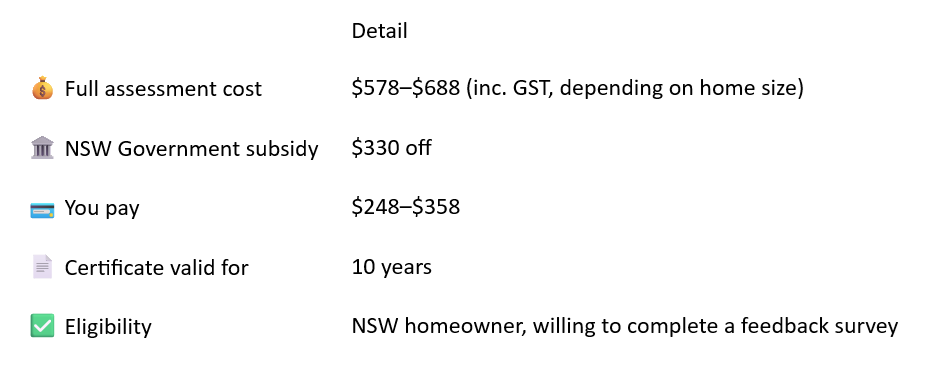
The assessment is valuable for two reasons: it tells you which upgrades to prioritise, and your certificate is evidence that may help qualify your home for a green home loan once upgrades are complete.
💡 Good news: The NatHERS assessment cost is itself an eligible expense under the NSW Home Energy Saver loan - so you can fund it at 0% interest (Step 2).
Step 2: Fund your upgrades through the NSW Home Energy Saver 💸
Armed with your NatHERS certificate and a prioritised list of recommended upgrades, you can now put the NSW Government's Home Energy Saver to work. The scheme offers a 0% interest loan of up to $15,000 (repayable over 10 years) and, for eligible lower-income households, an upfront discount of up to $4,000. If you qualify for both, you can stack them — just apply for the discount first.
The loan covers 12 categories of upgrade: solar, battery, heat pump hot water, reverse-cycle air conditioning, EV chargers, insulation, double glazing, induction cooktops and more.
👉 Full eligibility criteria, loan details and what the scheme covers:
Step 3: Stack with other government incentives 📋
The Home Energy Saver doesn't prevent you from accessing other programs at the same time. A few worth knowing about:
Small-scale Technology Certificates (STCs) If you install solar panels, you're entitled to STCs under the federal government's Small-scale Renewable Energy Scheme. These are typically applied as an upfront discount by your installer — reducing your out-of-pocket cost before the Home Energy Saver loan even kicks in.
Federal Household Energy Upgrades Fund (HEUF) The federal government's $1 billion HEUF provides discounted green finance through participating banks. If your upgrade costs exceed the Home Energy Saver limit, the HEUF can cover additional spending on solar, batteries, insulation, heat pumps, EV chargers and more.
The recommended order:
Book your ZapCat NatHERS assessment
Apply for the Home Energy Saver discount first (if eligible)
Claim STCs through your solar installer
Apply for the Home Energy Saver loan to cover the remaining cost
Top up with HEUF finance if needed
Step 4: Refinance to a green home loan 🌿
Your upgrades are done. Now put them to work on your mortgage too.
Once your upgrades are complete, your home may now qualify for a green home loan: a discounted mortgage rate offered by lenders who reward energy-efficient properties. With rate discounts typically ranging from 0.15% to 0.65% below standard variable, the long-term impact on your mortgage can dwarf every other saving in this list — we're talking tens of thousands of dollars over the life of the loan.
Already have solar? Your home may already qualify right now, without any further upgrades. A NatHERS certificate strengthens that application further.
👉 See the full mortgage savings breakdown:
What does the total picture look like?
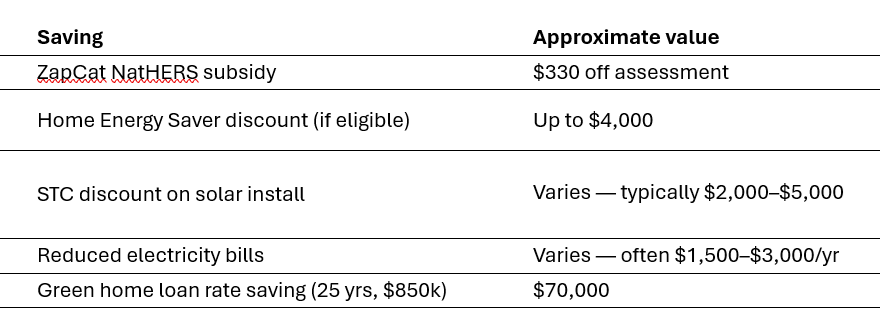
The upgrades pay for themselves in bill savings. The green loan saving is on top of that.
Where to start
If this feels like a lot to navigate, that's because it is — but you don't have to figure it out alone.
I work with NSW homeowners to map out exactly which programs they qualify for, what order to apply in, and which green lenders offer the best rates for their upgraded home. A free 20-minute call is all it takes to get clarity.